The Rise of AI in Security Tools: Transforming How We Defend Digital Assets
Explore how artificial intelligence is reshaping cybersecurity operations, from autonomous threat detection to AI-powered SOCs, and learn what security leaders need to know in 2025.
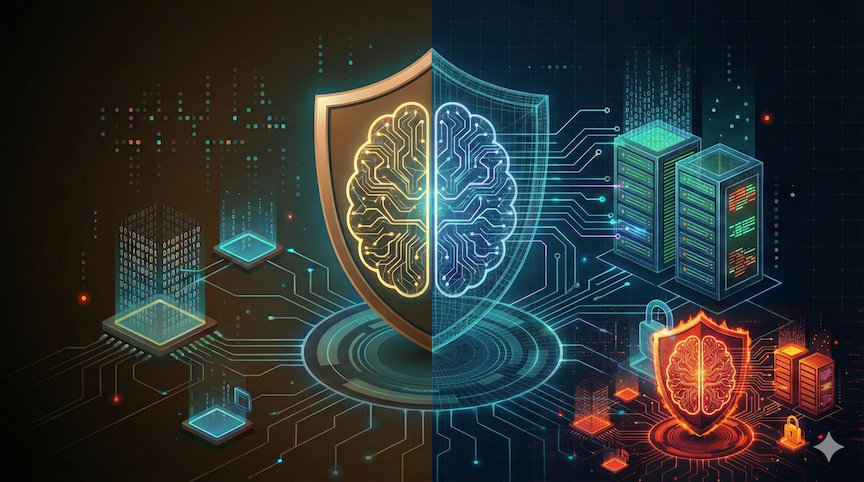
The cybersecurity industry finds itself at a pivotal crossroads. Threat actors have become faster, more sophisticated, and increasingly automated. Meanwhile, security teams face a persistent talent shortage and an ever-expanding attack surface. Into this gap steps artificial intelligence—not as a silver bullet, but as a force multiplier fundamentally changing how organizations detect, respond to, and prevent cyber threats.
The global AI in cybersecurity market surged past 25 billion dollars in 2024, accelerating toward projections of 86 to 94 billion dollars by 2030. According to Gartner, 45 percent of enterprises now run at least one production AI agent with access to critical business systems—a 300 percent increase from 2023. The growth reflects not just vendor hype but genuine demand from security teams struggling to keep pace with evolving threats.
The question is no longer whether to adopt AI in security operations, but how to do so effectively while managing the risks. This article examines the current state of AI in security tools, from threat detection to autonomous response, and provides a framework for evaluating and implementing these capabilities thoughtfully.
The Problem We Cannot Ignore
Traditional security operations centers face an impossible arithmetic. According to the AI SOC Market Landscape 2025 report, organizations face an average of 960 security alerts daily, with large enterprises seeing more than 3,000 alerts. Some SOCs receive upwards of 10,000 alerts per day. These alerts arrive around the clock, each potentially representing a genuine threat that requires human investigation, documentation, and response.
The human cost has become starkly apparent. More than 70 percent of SOC analysts report experiencing burnout, with 64 percent considering leaving their job within a year. The SANS 2025 survey reveals that 70 percent of SOC analysts with five years or less experience leave within three years, creating a perpetual training burden and institutional knowledge drain. The Osterman Research Report found that almost 90 percent of SOCs are overwhelmed by backlogs and false positives, while security experts spend 27 percent of their time handling false positives alone.
The consequences extend beyond employee wellbeing. A Devo report found that 83 percent of IT security professionals admit burnout has led to errors resulting in security breaches. When an analyst processing their 500th alert of the day clicks through too quickly, the actual malicious activity can slip through unnoticed. VentureBeat reports that SOC teams now face a "51-second breach reality"—the time between initial compromise and lateral movement in sophisticated attacks has compressed to under a minute, while manual response times remain measured in hours or days. The attackers have embraced automation, and defenders must do the same.
Understanding the AI Security Tool Landscape
Not all AI in security tools is created equal. The term "AI-powered" has become a marketing checkbox that obscures significant differences in capability and approach. Some vendors layer basic machine learning atop traditional rule-based systems, while others deploy sophisticated multi-model architectures capable of genuine reasoning about threats.
A clear expectation emerged in 2025: security teams prefer accuracy over speed, with current expectations settling around five minutes or less for alert triage and investigation tasks. An AI system that delivers verdicts in 30 seconds but generates 40 percent false positives creates more work than it solves. The best platforms balance speed with precision, delivering high-confidence decisions quickly while flagging edge cases for human review.
Threat Detection and Analysis
Machine learning models excel at establishing behavioral baselines and flagging anomalies that deviate from normal patterns. Unlike static signatures requiring known attack patterns, these systems identify novel threats based on behavioral characteristics. A traditional signature-based system might catch malware matching known hashes, but it will miss a newly compiled variant. Behavioral AI can identify suspicious process chains, unusual file access patterns, or anomalous network connections regardless of whether the specific attack has been seen before.
Modern AI operates across multiple data sources simultaneously—network traffic, endpoint telemetry, cloud workloads, and user behavior—correlating signals impossible for humans to synthesize at scale. A security analyst reviewing alerts might notice a failed login attempt on one screen and an unusual data transfer on another, but connecting those events across thousands of users and systems requires computational capacity humans simply lack.
Real-world deployments demonstrate measurable impact across various industries. In banking, one major institution's real-time platform resulted in a 65 percent reduction in account takeover incidents by correlating device fingerprints, behavioral biometrics, and transaction patterns in real time. The system learned what normal customer behavior looked like—typical login times, devices used, transaction patterns—and flagged deviations that human analysts would have missed in the noise.
Healthcare and financial services organizations reported up to an 80 percent drop in data exposure incidents within 60 days of AI deployment, primarily through better detection of insider threats and credential compromise. Manufacturing companies have deployed AI to monitor operational technology networks, detecting subtle anomalies in industrial control system communications that could indicate early-stage attacks on critical infrastructure.
The key differentiator isn't just detection accuracy but speed to verdict. Legacy systems might flag a suspicious event hours or days after it occurred, when the attack chain had already progressed. Modern AI systems operate in near real-time, identifying threats while containment remains possible.
The Evolution of SIEM, SOAR, and XDR
The traditional boundaries between Security Information and Event Management (SIEM), Security Orchestration and Automated Response (SOAR), and Extended Detection and Response (XDR) have begun dissolving. Each category emerged to address specific challenges: SIEM aggregates logs and maintains archives for compliance and forensic investigation. SOAR adds automation through playbooks that execute predefined response procedures without human intervention. XDR extends detection by incorporating endpoint, network, and cloud telemetry into a unified detection framework.
Modern platforms increasingly combine all three capabilities, recognizing that artificial boundaries between these functions create operational friction. When a threat is detected, analysts shouldn't need to switch between detection and response interfaces—the workflow should be seamless.
Microsoft Sentinel integrates AI-powered analysis with automated playbooks in a cloud-native architecture. The November 2025 announcement that Security Copilot will be available to all Microsoft 365 E5 customers dramatically expanded accessibility—organizations already paying for E5 licensing gain AI-augmented security at no additional cost. Palo Alto's Cortex XSIAM became the fastest product in company history to surpass one billion dollars in bookings, unifying SIEM, XDR, SOAR, and attack surface management into a single platform that processes over a petabyte of data daily across its customer base.
However, XDR should not be viewed as a complete SIEM replacement. Organizations with mature compliance requirements, particularly in regulated industries like financial services and healthcare, may still need dedicated SIEM capabilities for log retention, audit trails, and regulatory reporting. Complex multi-vendor environments also benefit from SIEM's vendor-agnostic log aggregation.
The Agentic SOC Emerges
Perhaps the most significant 2025 development is the rise of agentic AI in security operations. Unlike passive AI that waits for analyst direction before acting, agentic systems autonomously investigate alerts, gather context from multiple systems, and execute response actions within defined guardrails. When a suspicious login triggers an alert, an agentic system can independently query the identity provider, check the user's recent activity patterns, examine the source IP reputation, and determine whether the activity represents genuine compromise or benign anomaly—all before a human analyst even sees the alert.
Gartner research suggests multi-agent AI will grow from 5 percent to 70 percent of AI implementations by 2028. Omdia tracks more than 50 agentic SOC startups, with autonomous SOC evolution expected to become standard for CISOs within one to two years. The market is responding to genuine demand: security leaders recognize that human-speed response cannot match machine-speed attacks.
CrowdStrike's AgentWorks deploys specialized agents trained on 14 years of labeled threat telemetry, claiming 98 percent decision accuracy and 40 analyst hours saved weekly. Each agent focuses on a specific domain—malware analysis, network investigation, or identity verification—and they collaborate to build comprehensive threat pictures. Palo Alto's Cortex AgentiX, trained on 1.2 billion playbook executions, enables organizations to deploy pre-built agents or create custom ones without code, democratizing access to autonomous security capabilities.
The destination is not a fully autonomous SOC where machines operate without human involvement. Instead, the industry is moving toward a human-led, machine-accelerated model where SIEM provides visibility, XDR delivers prioritized incidents, SOAR ensures consistent response, and AI copilots contribute reasoning and investigation capacity. Humans set policy, handle edge cases, and maintain accountability while AI handles volume. Only 11 percent of enterprises report AI agents in production today—significant runway for growth remains.
Platform Comparison
The major security vendors have taken distinctly different approaches to AI integration, reflecting their existing market positions and technical architectures.
Microsoft Security Copilot represents the clearest "ecosystem play" in the market. Best suited for organizations already invested heavily in the Microsoft stack, Copilot integrates seamlessly with Sentinel, Defender, Entra, and the broader M365 suite. The Phishing Triage Agent identifies malicious emails 6.5 times faster with 77 percent improved accuracy compared to manual analysis. The November 2025 announcement that Security Copilot will be included in E5 licensing removes cost barriers that previously limited adoption to the largest enterprises. However, organizations running heterogeneous environments will find Copilot's advantages significantly diminished—it excels when analyzing Microsoft telemetry but provides less differentiated value for third-party tools.
CrowdStrike Charlotte AI brings unmatched threat intelligence depth from 14 years of labeled threat telemetry and billions of daily events processed across its customer base. Charlotte excels at endpoint detection, leveraging the Falcon platform's deep visibility into process behavior, file activity, and network connections. Organizations report strong efficiency gains, with some citing 40 analyst hours saved weekly. The premium pricing model may limit adoption for mid-market organizations, but enterprises facing sophisticated threats often find the investment justified by detection quality.
Palo Alto Cortex XSIAM offers the most comprehensive unified platform, combining SIEM, XDR, SOAR, and attack surface management in a single architecture. The platform aligns strongly with Zero Trust frameworks and excels in environments committed to the Palo Alto ecosystem across firewalls, cloud security, and endpoint protection. Organizations evaluating XSIAM should understand that maximum value extraction requires deep ecosystem adoption—the platform's strengths emerge from correlation across Palo Alto data sources.
SentinelOne Purple AI has emerged as a market leader in consolidating XDR, SIEM, and SOAR capabilities with a strong autonomous operation focus. The platform emphasizes natural language interaction, allowing analysts to query security data conversationally and receive actionable insights without complex query languages.
AI as Threat Vector
While security teams rush to adopt AI for defense, threat actors have access to the same technologies. Microsoft's 2025 Digital Threats Report revealed nation-state actors have more than doubled their use of AI for cyberattacks. According to Darktrace, 74 percent of cybersecurity professionals agree AI-powered threats pose significant challenges that existing defenses struggle to address.
Deepfakes and Social Engineering present immediate danger. In one notable incident, deepfakes of executives convinced an employee to transfer approximately 25 million dollars during what appeared to be a routine video conference call. The technology required to create convincing deepfakes has become accessible to threat actors with moderate technical sophistication. Attackers now deploy AI-generated voice messages that perfectly mimic executive speech patterns, highly personalized phishing messages that reference real internal projects scraped from social media, and video calls with fabricated participants indistinguishable from genuine colleagues. Organizations must implement out-of-band verification for high-stakes communications—a phone call to a known number, not the one provided in the suspicious communication.
Prompt Injection targets AI systems directly. As organizations deploy large language models for customer service, code analysis, and internal workflows, these systems become attack surfaces. The OWASP Top 10 for Large Language Models provides a comprehensive framework for these attack vectors, including direct injection where attackers feed malicious instructions to AI systems, indirect injection where malicious content is embedded in documents the AI processes, jailbreaking that bypasses safety guardrails, and model extraction attacks that attempt to steal proprietary training data or model weights.
Shadow AI creates pervasive risk. According to Lanai, 89 percent of AI use inside organizations goes unseen by IT and security teams. Employees use consumer AI tools like ChatGPT and Claude to summarize confidential documents, analyze proprietary data, and draft sensitive communications without understanding that their inputs may be stored, used to train future models, or processed in jurisdictions conflicting with data residency requirements. A single employee pasting customer data into an unvetted AI tool can create a compliance violation overnight.
Data Poisoning targets training processes with potentially devastating long-term consequences. Attackers manipulate training data to skew model outputs, create backdoors that activate on specific triggers, or gradually degrade detection capabilities. Unlike immediate attacks, data poisoning may not manifest for months, and attribution becomes extremely difficult when the attack vector is embedded in training data collected over time.
Gartner projects that by 2027, more than 40 percent of AI-related data breaches will stem from improper cross-border generative AI use, underscoring the need for comprehensive AI governance policies.
A Framework for Evaluating AI Security Tools
Detection Efficacy
Request proof-of-concept deployments with your actual data before committing to a platform. Vendor demonstrations using curated datasets rarely reflect real-world performance. Insist on testing against scenarios relevant to your specific threat model—if you're in financial services, test against credential stuffing and account takeover; if you're in healthcare, focus on ransomware and data exfiltration patterns.
Understand the training data underlying detection models and how frequently they update. Pay attention to how platforms handle novel attacks—systems trained exclusively on historical patterns may miss emerging techniques. Ask vendors about their research teams and how quickly new threat intelligence translates into detection capabilities.
Integration and Explainability
Evaluate integration with your current SIEM, endpoint protection, identity management, and cloud security tools. The most powerful AI becomes useless if it operates in isolation. Open APIs and standard data formats reduce friction and enable orchestration across your security ecosystem.
Black-box AI that generates alerts without explanation compounds alert fatigue rather than reducing it. Analysts need to understand why an AI flagged something as suspicious to trust its judgment and take appropriate action. Look for reasoning chains, confidence scores, and links to underlying telemetry. Platforms that incorporate analyst feedback into model updates create virtuous improvement cycles where the system learns from human expertise over time.
Governance and Compliance
The EU AI Act, GDPR, and industry-specific regulations increasingly require explainability in automated decision-making. Security tools that block access, quarantine files, or terminate sessions based on AI judgments may face regulatory scrutiny. Ensure platforms provide audit trails documenting what data was processed, what decisions were made, and what actions were taken.
Evaluate data residency carefully—where does AI processing occur? Many vendors process data in cloud environments that may cross jurisdictional boundaries. The Databricks AI Security Framework (DASF) 2.0 identifies 62 risks and 64 controls based on NIST and MITRE standards. Map vendor capabilities against these frameworks to identify gaps.
Vendor Viability
The market remains dynamic with significant consolidation activity. In 2025 alone, Palo Alto acquired Talon Cyber Security for 625 million dollars while Thoma Bravo completed a 5.3 billion dollar Darktrace acquisition. Evaluate financial stability, customer base diversity, and product roadmap clarity. Consider whether vendors build models in-house, partner with AI specialists, or rely on commercial foundation models—each approach carries different risk profiles for long-term support and differentiation.
Implementation Considerations
Successful AI integration in security operations requires more than selecting the right vendor. Organizations that achieve meaningful outcomes approach implementation thoughtfully, building capabilities incrementally rather than attempting wholesale transformation overnight.
Start with high-volume, well-understood use cases. Alert triage, threat intelligence enrichment, and investigation of common alert types like phishing and failed authentication offer low-risk starting points where AI can demonstrate value quickly. These use cases provide measurable outcomes—reduction in alert backlog, faster time to verdict—that justify further investment. Avoid enabling autonomous response actions for critical production systems until you've established confidence in the platform's judgment through supervised operation.
Establish governance before deployment. Define clearly what data AI systems can access, what actions they can take autonomously versus with approval, and who bears accountability when AI-driven actions cause problems. Create an AI security committee including stakeholders from security operations, privacy, compliance, and legal functions. Document decision frameworks before incidents occur, not during them.
Invest in training. Analysts who understand AI capabilities and limitations extract significantly more value than those who treat AI recommendations as opaque commands. Training should cover tool operation, interpreting AI recommendations and confidence scores, and knowing when to override machine judgments. Address cultural resistance proactively—communicate clearly that AI augments rather than replaces human expertise, and demonstrate how AI handles routine work to free analysts for more interesting investigations.
Measure meaningful outcomes. Focus on mean time to detect (MTTD), mean time to respond (MTTR), false positive rates, and analyst satisfaction rather than vanity metrics like alerts processed. Establish baselines before deployment and track consistently over time. Monthly reviews comparing AI-assisted metrics against pre-deployment baselines provide clear visibility into whether the investment is delivering value. If your AI investment isn't moving these numbers in the right direction, something needs adjustment—whether that's configuration tuning, additional training data, or reconsideration of the platform itself.
Plan for continuous improvement. Schedule quarterly detection efficacy reviews comparing AI performance against established baselines. Conduct annual assessments of tool portfolio alignment with evolving threats. Participate in user communities where peers facing similar challenges share insights that accelerate everyone's improvement.
Looking Ahead
The agentic AI trend will accelerate through the remainder of this decade. Today's autonomous alert triage will expand to autonomous investigation and eventually autonomous response for well-defined scenarios with clear boundaries. We will likely see AI systems that can not only detect a compromised credential but autonomously revoke access, initiate password resets, and notify affected users—all within seconds of detection.
The human role will shift toward strategic oversight, policy setting, threat hunting for novel attack vectors, and handling the edge cases that require judgment machines cannot yet replicate. This doesn't mean fewer security professionals—it means security professionals working on more interesting problems while AI handles the repetitive volume that currently drives burnout.
Collaboration between AI security tools will deepen through federated approaches that enable collective threat intelligence sharing while maintaining organizational privacy. Imagine a world where an attack pattern detected at one organization immediately improves detection capabilities across thousands of others, without exposing sensitive details about the original target. Several vendors are already building toward this vision.
Adversarial AI capabilities will continue advancing—organizations failing to keep pace will find themselves increasingly vulnerable to attacks that move faster than human response allows. The asymmetry between automated attack and manual defense simply cannot persist.
The 93 percent of security professionals who believe AI can help ensure cybersecurity are likely correct—but so are the 77 percent finding their organizations unprepared to harness it effectively. Closing this readiness gap requires investment not just in tools but in processes, skills, and organizational adaptation. The technology exists; the challenge is organizational maturity.
The time to begin thoughtful AI integration is now.
References
- Grand View Research - AI in Cybersecurity Market Analysis
- Lakera - AI Security Trends 2025
- OWASP Gen AI Security Project
- Microsoft - Generative AI Security Threats
- Omdia - The Agentic SOC
- Palo Alto Networks - GenAI Security Risks
- SANS Institute - Breaking the SOC Analyst Burnout Cycle
- Dark Reading - SOC Analyst Burnout Statistics
- VentureBeat - SOC Teams Face 51-Second Breach Reality
- Exaforce - Top AI SOC Platforms 2025
- Microsoft Security - Microsoft Sentinel
---
Until next time, Protect Yourselves and Safeguard each other.
Share this article
Comments
Comments are powered by GitHub Discussions via Giscus.
To enable comments, configure Giscus at giscus.app and update the Comments component with your repo settings.