Federated Learning: Privacy-Preserving Machine Learning in Practice
Learn how federated learning enables collaborative ML model training while keeping data at its source. Practical guide with TensorFlow Federated and Flower examples for healthcare, finance, and edge computing use cases.
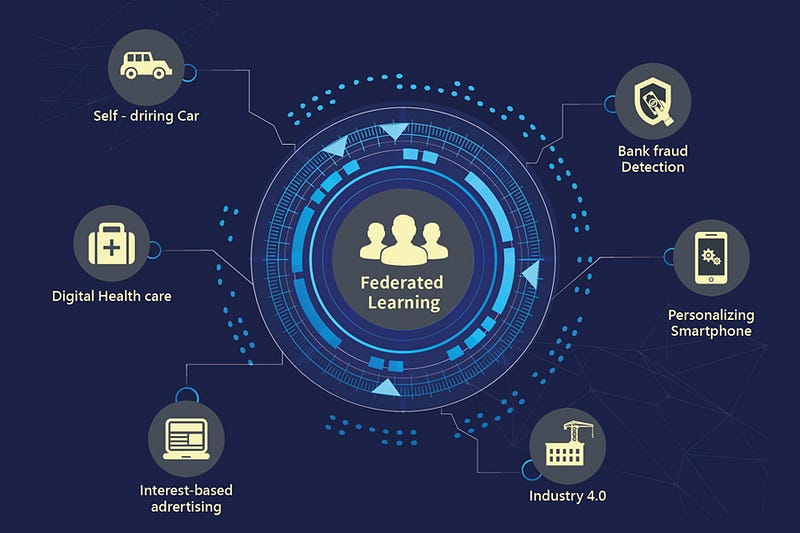
Modern machine learning thrives on data—the more diverse and abundant, the better. Yet this hunger for data collides with an equally powerful force: the growing demand for privacy. Organizations want to build intelligent systems, but users and regulators increasingly resist centralizing sensitive information. Federated Learning offers a way through this tension, enabling collaborative model training while keeping data where it originates.
The concept has moved well beyond academic papers. Google has deployed federated learning across billions of Android devices for keyboard predictions since 2017. Apple uses on-device learning for Siri, QuickType, and photo recognition. Healthcare consortiums train diagnostic models across hospital systems without sharing patient records. The federated learning market is projected to reach $210 million by 2028, growing at 12% annually as organizations seek privacy-preserving ML approaches.
What Is Federated Learning?
Federated Learning is a distributed approach to machine learning where the data never leaves its source. Instead of gathering information into a central repository for training, FL brings the model to the data. A coordinating server distributes a global model to participating clients—whether smartphones, hospital systems, or corporate data centers—and each client trains the model using its local data. The clients then send back only their model updates, not the underlying data. The server aggregates these updates, improves the global model, and begins the next round. This cycle continues until the model reaches acceptable performance.
The elegance of this approach lies in what it avoids. Sensitive medical records never travel across networks. Personal messages never reach company servers. Financial transactions stay within institutional boundaries. Yet the collective intelligence embedded in all this distributed data still flows into the shared model through carefully constructed updates.
The standard federated averaging (FedAvg) algorithm follows this pattern:
# Simplified FedAvg algorithm
def federated_averaging(global_model, clients, rounds):
    for round in range(rounds):
        # 1. Server sends global model to selected clients
        selected_clients = random.sample(clients, k=num_clients_per_round)

        client_updates = []
        for client in selected_clients:
            # 2. Each client trains on local data
            local_model = copy.deepcopy(global_model)
            local_model = train_on_local_data(local_model, client.data)

            # 3. Client sends model update (not data)
            update = compute_model_delta(global_model, local_model)
            client_updates.append((update, len(client.data)))

        # 4. Server aggregates updates weighted by data size
        global_model = weighted_average(global_model, client_updates)

    return global_model
Two Flavors of Federation
The nature of participating clients shapes how federated systems are designed and deployed.
Cross-Device Federation operates across vast fleets of consumer devices—smartphones predicting your next word, fitness trackers learning health patterns, smart home devices anticipating your preferences. These environments present unique challenges: devices connect intermittently, computational resources vary wildly, and participants constantly join and leave the network. Google's Gboard keyboard prediction trains across millions of phones, but any given device participates only when charging, connected to WiFi, and idle. The system must tolerate this chaos gracefully.
Cross-Silo Federation connects organizations rather than devices. Hospitals collaborating on diagnostic models, banks sharing fraud detection insights, or research institutions pooling scientific knowledge—all without actually pooling their data. These environments assume reliable infrastructure and stable participation, but introduce different complexities around governance, competitive dynamics, and regulatory compliance. When pharmaceutical companies want to improve drug interaction predictions using their combined patient data, the technical challenge of federation intersects with legal agreements, audit requirements, and trust frameworks.
Comparison: Cross-Device vs. Cross-Silo Federation

Characteristic          Cross-Device              Cross-Silo
────────────────────────────────────────────────────────────────────
Participants            Millions of devices       Tens of organizations
Connectivity            Intermittent, variable    Reliable, consistent
Data per client         Small (KB to MB)          Large (GB to TB)
Client availability     Unpredictable             Scheduled, contractual
Trust model             Anonymous clients         Known, contracted parties
Example                 Mobile keyboard           Hospital consortium
Frameworks              TFF, Flower               NVIDIA FLARE, OpenFL
Why This Matters Now
The convergence of several trends has thrust Federated Learning from academic curiosity to practical necessity.
Privacy regulations have teeth. GDPR in Europe, CCPA in California, HIPAA in healthcare, and the EU AI Act—these frameworks impose real constraints on how organizations collect, store, and process personal information. The EU AI Act specifically recognizes privacy-preserving techniques like federated learning as approaches that can reduce compliance burden for high-risk AI systems. FL doesn't eliminate compliance obligations, but it fundamentally changes the risk calculus by avoiding data centralization in the first place.
Meanwhile, the data that matters most often can't move. A hospital's patient records represent years of accumulated clinical insight, but sharing them—even for beneficial research—triggers legal, ethical, and practical barriers. The same applies to financial transaction histories, proprietary manufacturing data, and countless other valuable datasets locked behind organizational walls. Federation provides a path to collective intelligence without requiring data liberation.
Edge devices have also grown capable enough to contribute meaningfully. Modern smartphones carry neural engines capable of training small models locally. Apple's A-series and M-series chips include dedicated ML accelerators. Qualcomm's Snapdragon AI Engine enables on-device training. This distributed computational capacity represents an untapped resource that Federated Learning harnesses.
Practical Implementation with Flower
Flower (flwr) has emerged as the most accessible framework for federated learning experimentation and production deployment. It supports any ML framework (PyTorch, TensorFlow, JAX) and handles the federation orchestration.
Install Flower and dependencies:
pip install flwr torch torchvision
Define a simple federated client:
# client.py
import flwr as fl
import torch
import torch.nn as nn
import torch.optim as optim
from torch.utils.data import DataLoader

class SimpleNet(nn.Module):
    def __init__(self):
        super().__init__()
        self.fc1 = nn.Linear(784, 128)
        self.fc2 = nn.Linear(128, 10)

    def forward(self, x):
        x = x.view(-1, 784)
        x = torch.relu(self.fc1(x))
        return self.fc2(x)

class FlowerClient(fl.client.NumPyClient):
    def __init__(self, model, trainloader, testloader):
        self.model = model
        self.trainloader = trainloader
        self.testloader = testloader

    def get_parameters(self, config):
        return [val.cpu().numpy() for val in self.model.state_dict().values()]

    def set_parameters(self, parameters):
        params_dict = zip(self.model.state_dict().keys(), parameters)
        state_dict = {k: torch.tensor(v) for k, v in params_dict}
        self.model.load_state_dict(state_dict, strict=True)

    def fit(self, parameters, config):
        self.set_parameters(parameters)

        optimizer = optim.SGD(self.model.parameters(), lr=0.01)
        criterion = nn.CrossEntropyLoss()

        self.model.train()
        for epoch in range(1):  # Local epochs
            for images, labels in self.trainloader:
                optimizer.zero_grad()
                outputs = self.model(images)
                loss = criterion(outputs, labels)
                loss.backward()
                optimizer.step()

        return self.get_parameters(config), len(self.trainloader.dataset), {}

    def evaluate(self, parameters, config):
        self.set_parameters(parameters)

        criterion = nn.CrossEntropyLoss()
        correct, total, loss = 0, 0, 0.0

        self.model.eval()
        with torch.no_grad():
            for images, labels in self.testloader:
                outputs = self.model(images)
                loss += criterion(outputs, labels).item()
                _, predicted = torch.max(outputs, 1)
                total += labels.size(0)
                correct += (predicted == labels).sum().item()

        accuracy = correct / total
        return loss / len(self.testloader), total, {"accuracy": accuracy}

# Start client
if __name__ == "__main__":
    model = SimpleNet()
    trainloader, testloader = load_data()  # Your data loading function

    client = FlowerClient(model, trainloader, testloader)
    fl.client.start_numpy_client(server_address="localhost:8080", client=client)
Define the federation server:
# server.py
import flwr as fl
from flwr.server.strategy import FedAvg

# Define aggregation strategy
strategy = FedAvg(
    fracti           # Sample 50% of clients per round
    fracti       # Evaluate on 50% of clients
    min_fit_clients=2,           # Minimum clients for training
    min_evaluate_clients=2,      # Minimum clients for evaluation
    min_available_clients=2,     # Wait for at least 2 clients
)

# Start server
fl.server.start_server(
    server_address="0.0.0.0:8080",
    c
    strategy=strategy,
)
Run the federation:
# Terminal 1: Start server
python server.py

# Terminal 2: Start client 1
python client.py

# Terminal 3: Start client 2
python client.py
TensorFlow Federated for Research
TensorFlow Federated (TFF) provides a more research-oriented framework with stronger abstractions for federated computation. It's particularly well-suited for cross-device scenarios and differential privacy integration.
# TensorFlow Federated example
import tensorflow as tf
import tensorflow_federated as tff

# Define model function
def create_keras_model():
    return tf.keras.Sequential([
        tf.keras.layers.InputLayer(input_shape=(784,)),
        tf.keras.layers.Dense(128, activation='relu'),
        tf.keras.layers.Dense(10, activation='softmax')
    ])

def model_fn():
    keras_model = create_keras_model()
    return tff.learning.models.from_keras_model(
        keras_model,
        input_spec=preprocessed_example_dataset.element_spec,
        loss=tf.keras.losses.SparseCategoricalCrossentropy(),
        metrics=[tf.keras.metrics.SparseCategoricalAccuracy()]
    )

# Build federated averaging process
federated_averaging = tff.learning.algorithms.build_weighted_fed_avg(
    model_fn,
    client_optimizer_fn=lambda: tf.keras.optimizers.SGD(learning_rate=0.01),
    server_optimizer_fn=lambda: tf.keras.optimizers.SGD(learning_rate=1.0)
)

# Initialize and run training
state = federated_averaging.initialize()

for round_num in range(10):
    # Sample client datasets for this round
    sampled_clients = sample_clients(federated_train_data, num_clients=10)

    # Run one round of federated averaging
    result = federated_averaging.next(state, sampled_clients)
    state = result.state
    metrics = result.metrics

    print(f'Round {round_num}: loss={metrics["client_work"]["train"]["loss"]:.4f}')
Adding Differential Privacy
Differential privacy provides mathematical guarantees that individual contributions cannot be reverse-engineered from model updates. TensorFlow Federated integrates differential privacy natively:
import tensorflow_federated as tff
from tensorflow_privacy.privacy.dp_query import gaussian_query

# Configure differential privacy parameters
dp_query = gaussian_query.GaussianSumQuery(
    l2_norm_clip=1.0,       # Clip gradient norm
    stddev=0.1               # Noise standard deviation
)

# Build DP-enabled federated averaging
dp_federated_averaging = tff.learning.algorithms.build_weighted_fed_avg(
    model_fn,
    client_optimizer_fn=lambda: tf.keras.optimizers.SGD(learning_rate=0.01),
    server_optimizer_fn=lambda: tf.keras.optimizers.SGD(learning_rate=1.0),
    model_aggregator=tff.learning.robust_aggregator(
        zeroing=True,
        clipping=True,
        clipping_norm=1.0
    )
)

# Privacy budget tracking
# epsilon accumulates over rounds - track to maintain guarantees
total_epsilon = 0.0
delta = 1e-5

for round_num in range(num_rounds):
    result = dp_federated_averaging.next(state, sampled_clients)
    state = result.state

    # Compute privacy spent this round (simplified)
    round_epsilon = compute_epsilon(noise_multiplier, num_clients, delta)
    total_epsilon += round_epsilon

    print(f'Round {round_num}: ε={total_epsilon:.2f}, δ={delta}')
Navigating the Challenges
Federated Learning is not a panacea. The approach introduces complexities that centralized training avoids, and pretending otherwise leads to failed deployments.
The Heterogeneity Problem
When training happens across diverse environments, uniformity becomes the exception rather than the rule. Data distributions differ dramatically between participants. Some users type in formal English; others use slang, emoji, and code-switching between languages. Some hospitals serve elderly populations; others specialize in pediatrics.
This heterogeneity—what researchers call "non-IID data" (not independently and identically distributed)—wreaks havoc on naive aggregation strategies. Standard averaging works beautifully when all participants see similar data, but produces mediocre models when participants occupy different corners of the data landscape.
FedProx addresses this by adding a proximal term that keeps local models closer to the global model:
# FedProx modification to local training
def fedprox_local_training(global_model, local_model, data, mu=0.01):
    """
    FedProx adds proximal term: mu/2 * ||w - w_global||^2
    This regularizes local updates toward global model
    """
    optimizer = optim.SGD(local_model.parameters(), lr=0.01)
    criterion = nn.CrossEntropyLoss()

    global_params = {name: param.clone() for name, param in global_model.named_parameters()}

    for epoch in range(local_epochs):
        for images, labels in data-blocked:
            optimizer.zero_grad()

            # Standard loss
            outputs = local_model(images)
            loss = criterion(outputs, labels)

            # Proximal term: keeps local model close to global
            proximal_term = 0.0
            for name, param in local_model.named_parameters():
                proximal_term += ((param - global_params[name]) ** 2).sum()

            loss += (mu / 2) * proximal_term

            loss.backward()
            optimizer.step()

    return local_model
Security in Hostile Environments
Opening model training to distributed participants creates attack surfaces that centralized training doesn't expose. Model poisoning involves submitting updates designed to degrade performance or introduce backdoors.
Byzantine-fault-tolerant aggregation limits how much any single participant can influence results:
def byzantine_robust_aggregation(updates, method='trimmed_mean', trim_ratio=0.1):
    """
    Robust aggregation that tolerates malicious updates
    """
    if method == 'trimmed_mean':
        # Sort and trim extreme values before averaging
        stacked = torch.stack(updates)
        n = len(updates)
        trim_count = int(n * trim_ratio)

        sorted_updates, _ = torch.sort(stacked, dim=0)
        trimmed = sorted_updates[trim_count:n-trim_count]
        return trimmed.mean(dim=0)

    elif method == 'median':
        # Use coordinate-wise median
        stacked = torch.stack(updates)
        return stacked.median(dim=0).values

    elif method == 'krum':
        # Select update closest to others (excluding outliers)
        n = len(updates)
        f = int(n * 0.2)  # Assume up to 20% Byzantine

        scores = []
        for i, update_i in enumerate(updates):
            distances = []
            for j, update_j in enumerate(updates):
                if i != j:
                    distances.append(torch.norm(update_i - update_j).item())
            distances.sort()
            scores.append(sum(distances[:n-f-2]))

        best_idx = scores.index(min(scores))
        return updates[best_idx]
Real-World Applications
Healthcare Without Data Sharing
NVIDIA Clara Federated Learning enables healthcare institutions to collaborate without sharing patient data. The platform has been deployed for COVID-19 research, training models across 20 hospitals in five continents while keeping all patient data local.
# NVIDIA FLARE (Federated Learning Application Runtime Environment)
# Server configuration for healthcare FL

# config_fed_server.json
{
    "format_version": 2,
    "min_clients": 3,
    "num_rounds": 50,
    "workflows": [
        {
            "id": "scatter_and_gather",
            "path": "nvflare.app_common.workflows.scatter_and_gather.ScatterAndGather",
            "args": {
                "min_clients": 3,
                "num_rounds": 50,
                "start_round": 0,
                "wait_time_after_min_received": 10
            }
        }
    ],
    "components": [
        {
            "id": "model_selector",
            "path": "nvflare.app_common.widgets.intime_model_selector.IntimeModelSelector",
            "args": {"aggregation_weights": {"accuracy": 1.0}}
        }
    ]
}
Financial Intelligence Without Exposure
Fraud detection particularly benefits from cross-institutional learning. Patterns visible across banks might be invisible to each bank individually. Organizations like SWIFT are exploring federated approaches for transaction monitoring.
Smart Cities Without Surveillance
Traffic management systems can learn from vehicle patterns without creating centralized movement records. Barcelona's smart city initiative uses edge computing combined with federated approaches for traffic optimization while maintaining citizen privacy.
Framework Comparison
Framework           Best For                    ML Frameworks       Production Ready
──────────────────────────────────────────────────────────────────────────────────────
Flower              General FL, prototyping     Any (PyTorch, TF)   Yes
TensorFlow Fed      Research, cross-device      TensorFlow          Yes (simulation)
NVIDIA FLARE        Healthcare, enterprise      PyTorch, TF         Yes
PySyft              Privacy research            PyTorch             Experimental
OpenFL (Intel)      Enterprise deployment       PyTorch, TF         Yes
FedML               Edge AI, mobile             PyTorch             Yes
Install and compare:
# Flower - most accessible
pip install flwr

# TensorFlow Federated - research focused
pip install tensorflow-federated

# NVIDIA FLARE - enterprise healthcare
pip install nvflare

# FedML - edge computing focus
pip install fedml
Getting Started
If you're exploring federated learning for your organization:
Week 1-2: Feasibility Assessment
Identify use cases where data cannot or should not be centralized. Evaluate whether the ML task benefits from collaborative training across data silos. Assess client device capabilities and network constraints.
Week 3-4: Framework Selection
For prototyping, start with Flower—it's framework-agnostic and has the gentlest learning curve. For healthcare or enterprise deployment, evaluate NVIDIA FLARE. For research or cross-device scenarios, consider TensorFlow Federated.
Week 5-6: Prototype Development
Build a simple federated version of your model using simulated clients. Test with IID data first to validate the infrastructure, then introduce non-IID distributions to stress-test aggregation.
Week 7-8: Privacy Integration
Add differential privacy if individual privacy guarantees are required. Implement secure aggregation if model updates themselves are sensitive. Test privacy-utility tradeoffs.
Federated learning represents a fundamental shift in how ML systems can be built—enabling collaborative intelligence while respecting data sovereignty. The approach addresses growing regulatory pressure around data centralization while unlocking value from data that could never be pooled. As privacy expectations continue rising and edge devices grow more capable, federation will become a standard tool in the ML practitioner's toolkit rather than a specialized technique.
Until next time, "Protect Yourselves and Safeguard Each Other"
— Sean
---
Further Reading
Share this article
Comments
Comments are powered by GitHub Discussions via Giscus.
To enable comments, configure Giscus at giscus.app and update the Comments component with your repo settings.